
The Memory That Fed Us
Black community, Decoration Day, and the African Ways of Knowing America keeps borrowing
Yesterday, May 23, 2028, I had an experience that was not unique.
That is the point.
It was not a miracle. It was not a sentimental little moment dropped from heaven so everybody could clap and call it “beautiful.” It was ordinary Black community practice. It touched me because I had not experienced it in a while, at least not in that form. Sometimes the thing you grew up inside has to reappear in public before you remember how much structure was holding you all along.
My wife and I were sitting in a park. I was working. A Black American woman walked in front of us on her way to a children’s party. She could have been my big sister. Or maybe just a sister, because we looked close enough in age.
I stopped her and joked, asking her to bring me some food.
It was Black folk community banter. Nothing formal. Nothing staged. No branding. No nonprofit language. No “community engagement strategy,” because Lord knows America can turn a plate of food into a grant proposal if you give it enough time.
I made it clear I was joking. She laughed it off and kept moving toward the party.
About an hour later, two young adults came back and asked whether my wife and I wanted something to eat.
I told them I had only said it jokingly to a lady who had passed by earlier. One of them explained that the woman was her grandmother.
My wife and I were deeply touched.
Afterward, I told my wife: this is what it is like to live in the Black community seven days out of seven.
Not because everything is perfect. It is not. We do not need fantasy to defend ourselves. Fantasy is what weak analysis uses when truth feels too expensive. Black communities have problems because Black communities are human communities under pressure. But creating community has never been our weakest point.
We know how to see people. We know how to turn a joke into recognition. We know how to turn food into relationship. We know how to turn public space into Black place.
That young person came back because a grandmother carried a code. Maybe she spoke it plainly. Maybe she did not have to say much. Maybe the code was already alive in the family. Either way, the knowledge moved.
Somebody was seen.
Somebody was fed.
A park became community.
That was not random kindness. That was a living memory system doing what it has always done: recognizing kinship, creating obligation, and refusing to let people stand outside the circle when the community has enough to bring them in.
The Ordinary Was the Institution
That moment brought back countless memories.
Neighbors looking out for neighbors. Conversations at the fence. Simple favors that were not simple when you needed them. Extraordinary favors that nobody posted about because they were not trying to build a platform. They were trying to build people.
I thought about neighborhood community fathers.
For me, that man was Mr. Robert Herman Jones Jr.
He was my neighbor. He was a father figure. He was a friend. He was also a community policeman. After he sheltered me as a fatherless child, and after I became an adult, I would routinely stop and talk with him. Sometimes I would intentionally visit him.
He did not need a title to be an institution.
That is one thing America often fails to understand about Black life. Governance is not only what happens in city hall, Congress, courts, agencies, police departments, school boards, foundations, or official committees.
Governance is also how a people organize care, protect children, correct behavior, preserve memory, teach responsibility, and hold one another together before the formal system gets around to noticing they exist.
Mr. Jones was governance.
The grandmother in the park was governance.
The young adults who came back with the offer of food were governance.
Not government.
Governance.
There is a difference. Government asks who has legal authority. Governance asks who is carrying responsibility.
Black people have survived because we learned to carry responsibility in places where formal systems ignored us, used us, feared us, studied us, regulated us, or treated us like a problem to be managed. We built a world inside a world. We built networks of aunties, uncles, church mothers, deacons, coaches, barbers, teachers, neighbors, community policemen, card-table philosophers, porch historians, kitchen economists, and grandmothers who could run a whole block with one look.
And somehow America keeps acting surprised that we are still here.
Come on now.
The Name Beneath the Practice
In the Black community, even when we did not use the formal language, we were living inside African Ways of Knowing.
We called it home training. We called it respect. We called it checking on people. We called it bringing a plate. We called it speaking when you enter a room. We called it not letting children act like they fell out of the sky with no people attached to them. We called it remembering who raised you. We called it church, family, neighborhood, and common sense.
But underneath those words was a deeper knowledge system.
African Ways of Knowing are not decorative values. They are ways of preserving relationship, duty, memory, love, spirit, education, survival, listening, lineage, ritual, place, communal obligation, warning, repair, dignity, and future responsibility.
That is not anthropology sitting behind glass.
That is life under pressure organized into wisdom.
It is the practice of knowing that a person is not only an individual. A person belongs to people, place, memory, institution, power, responsibility, and future.
That is why food matters. That is why funerals matter. That is why music matters. That is why names matter. That is why elders matter. That is why how you speak to somebody matters. That is why a joke in a park can become a small act of community.
We were told knowledge had to sit in books, degrees, archives, and institutions. But Black people carried knowledge in kitchens, barbershops, churches, funerals, songs, porches, card tables, Sunday plates, school hallways, funeral repasts, and somebody’s grandmother telling the young people to go back and ask those folks whether they wanted something to eat.
That is an archive too.
It may not be bound in leather, but it is binding.
Decoration Day Was Not Just Remembrance
That brings me to Memorial Day.
Or, as it was known in the late 1800s, Decoration Day.
Before Memorial Day became a long weekend, a mattress sale, a cookout, and a vague patriotic gesture, Black people had already practiced the moral work of remembrance.
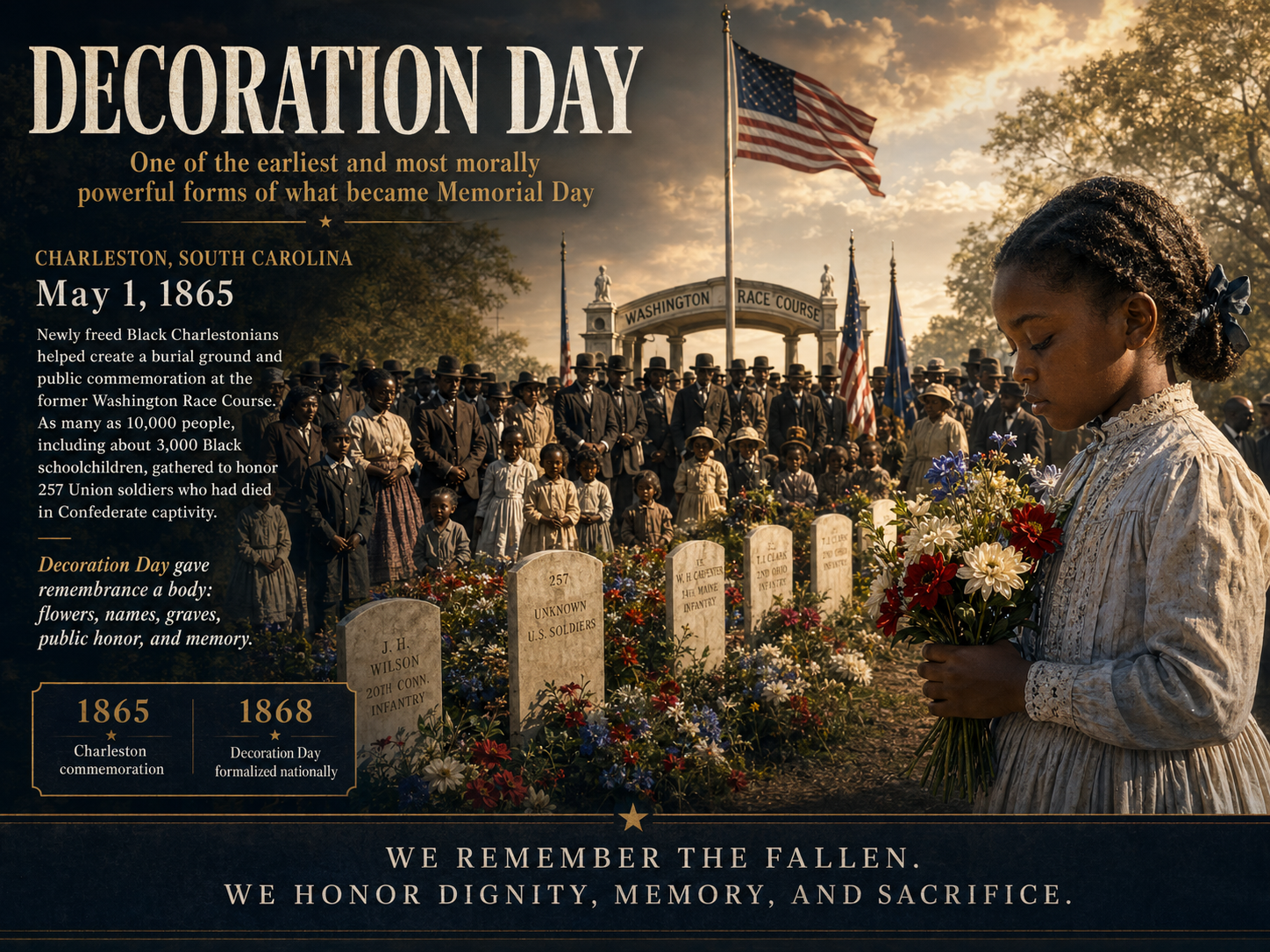
Newly freed Black people helped give Memorial Day one of its earliest and most morally powerful forms on May 1, 1865, in Charleston, South Carolina. At the former Washington Race Course, where 257 Union soldiers had died in Confederate captivity and had been buried in a mass grave, Black Charlestonians helped create a proper burial ground and gathered in public ceremony to honor them. The commemoration reportedly drew as many as 10,000 people, including about 3,000 Black schoolchildren, along with U.S. Colored Troops and a small group of white Charlestonians.
That was not just a ceremony.
That was burial as repair.
That was memory as governance.
That was a Black community saying: these dead will not be discarded.
The act matters because mass graves are not only about death. They are about erasure. A mass grave says the person does not need a name, a place, a ritual, a marker, or a community to speak on their behalf. It is what power does when it wants disposal without accountability.
Decoration Day answered that.
Black people took the dead out of erasure and placed them back into memory.
There may not be a single traceable line from that Charleston ceremony back to one specific African ritual. History does not always leave receipts in the format modern institutions prefer. Convenient, isn’t it?
But the practice itself is deeply familiar across African and African-descended worlds: honoring the dead, maintaining memory, gathering in public ritual, feeding the living, naming sacrifice, and refusing to let death sever responsibility.
That is why Decoration Day belongs inside this essay.
Because what happened in that park and what happened in Charleston are not the same event, but they share a structure.
A person is seen. A body is not discarded. A community takes responsibility. Memory becomes action. The living are reminded who they are.
That is Black governance.
That is African Ways of Knowing in American soil.
The Structure America Keeps Renaming
Through history, African Ways of Knowing have been discounted, misunderstood, mocked, borrowed, imitated, commercialized, and then renamed.
We have been trained to discredit Africa because Africa was not always treated as the first author of written systems recognized by Europe. As if writing is the only form of knowledge. As if memory, ritual, music, agriculture, architecture, healing, navigation, governance, oral history, cosmology, and community survival do not count until Europe stamps the paperwork.
That trick got old a long time ago.
African memory and Black tradition have come to life over and over again in America.
You can see it in food: rice, okra, gumbo, greens, black-eyed peas, barbecue methods, seasoning traditions, and the spiritual technology of feeding people through scarcity, celebration, mourning, and Sunday.
You can hear it in music: spirituals, blues, jazz, gospel, rock and roll, funk, soul, rap, hip-hop, call-and-response, polyrhythm, improvisation, testimony, protest, and joy with a scar in it.
You can feel it in worship: the call, the response, the moan, the shout, the testimony, the choir, and the preacher who knows language is not only information but movement.
You can see it in funerals and memorials: the homegoing, the repast, the procession, the songs, the flowers, the stories, and the laughter that shows up even while tears are still wet because Black people know grief and joy have been sitting on the same pew for generations.
You can hear it in language: signifying, verbal play, coded speech, Black English, timing, cadence, and humor sharp enough to cut and soft enough to heal. The kind of speech America mocks on Monday and monetizes by Friday.
Same old trick: take the drum, sell the concert, forget the drummer.
A lot of what America calls “American culture” is really African retention, Black adaptation, and commercial repackaging.
America has often treated Black culture like a buffet: take the food, take the sound, take the style, take the language, take the emotion, and leave the people standing at the door.
But African Ways of Knowing have not only kept Black Americans focused. They have helped keep America going.
They have been like veins and arteries in the body, carrying blood and oxygen to the heart, lungs, and limbs.
America keeps acting like these things are decorations.
They are circulation.
Without them, the body weakens.
Without them, the body dies.
The Platform Is the New Porch
This is why I give a big ups to SiriusXM Urban View, The Knarrative, KNubia, Dr. Greg Carr, and Professor Karen Hunter.
That is not just a shoutout.
It is a structural point.
The Black community has always needed spaces where we can remember together, study together, argue together, laugh together, sharpen one another, and keep our people front and center.
Sometimes that space was the porch. Sometimes it was the church basement. Sometimes it was the barbershop. Sometimes it was the HBCU classroom. Sometimes it was the Black bookstore. Sometimes it was Black radio.
Now sometimes it is a digital platform.
The porch has not disappeared. Sometimes it has a microphone, a livestream, a chat room, a reading list, and more than two thousand people trying to remember together.
That matters.
Because African Ways of Knowing are often unknown by name in America, but they are felt everywhere. What we see in spaces like In Class with Carr is an intentional effort to know what we have been carrying, to name it, study it, discipline it, and pass it forward.
That is not content.
That is Black study.
That is memory infrastructure.
That is community governance in digital form.
This is where the modern struggle sits. If we do not protect these spaces, they will be flattened into content, mined for style, harvested for language, and repackaged by platforms that love Black attention more than Black autonomy.
And there it is again: take the oxygen, forget the lungs.
Black Space, Black Place, Black Pace
Dr. Carr often gives us language for what we already know in our bones.
One frame from his May 23, 2026 class speaks directly to this essay: Black space, Black place, and Black pace.
Black space is where we gather.
Black place is what space becomes when memory, responsibility, and institution attach to it.
Black pace is how a people move when they are not waiting for permission to remember, feed, bury, teach, protect, and fight.
The park was Black space. The grandmother’s instruction turned it into Black place. The young adults coming back with the offer of food was Black pace.
Decoration Day was Black space. The reburial of the Union dead turned it into Black place. The public ceremony became Black pace.
Urban View, The Knarrative, KNubia, and In Class with Carr are Black space. The study, memory, and community turn them into Black place. The work of teaching, organizing, reading, remembering, and transmitting becomes Black pace.
That is the structure.
It is not sentiment. It is not nostalgia. It is not “good vibes.” It is people, place, memory, institution, power, responsibility, and future moving together.
The Fight Is Memory
So yes, I am thinking about Memorial Day.
I am thinking about Decoration Day.
I am thinking about Union soldiers, Black schoolchildren, U.S. Colored Troops, mass graves, flowers, food, grandmothers, neighborhood fathers, radio classrooms, digital communities, and children’s parties in the park.
I am thinking about how much America has borrowed from a people it keeps trying to misunderstand.
I am thinking about the fact that our strongest point was always, and will always be, our community, our memories, our determination, and our fight. These are characteristics we began in Africa and were forced to hone in America.
That word “forced” matters.
We did not become communal because America was kind. We became sharper because America was dangerous. We became creative because formal systems excluded us. We became musical because sound and lyrics could travel where law would not. We became memory-keepers because official archives kept lying by omission. We became community because isolation was one of the weapons used against us.
That does not mean every Black space is healthy. That does not mean every Black institution is coherent. That does not mean every elder is wise, every platform is liberating, or every tradition should be preserved without examination.
Again, we do not need fantasy.
But the structure is real.
Black community is not just a good feeling.
It is an institution.
Black memory is not nostalgia.
It is infrastructure.
African Ways of Knowing are not decorations on American life.
They are part of the circulation system that has kept this country breathing, even while the country kept trying to deny the source of the oxygen or snatch its own oxygen mask right off its American face.
So the task is not only to remember.
The task is to keep building Black space, protecting Black place, and moving at Black pace.
We must name the structure. We must credit the carriers. We must build the archives. We must support the platforms. We must teach the youth. And we must stop letting America borrow the oxygen while pretending it invented breathing.
Reflection: From Decoration Day to Memorial Day
The grave-decorating practice that came to be called Decoration Day gave remembrance a body: flowers, names, burial grounds, processions, and public honor for the fallen. In Charleston on May 1, 1865, newly freed Black people helped give that practice one of its earliest and most morally powerful forms when as many as 10,000 people, including about 3,000 Black schoolchildren, gathered to honor 257 Union soldiers who had died in Confederate captivity. In 1868, Decoration Day was formalized nationally through the Grand Army of the Republic, and over time it became Memorial Day, the national calendar for honoring those who died in military service. What we should remember is not only the holiday’s evolution, but the people at its center: service members who gave their lives, families who carried the loss, and communities that insisted the dead deserved dignity, memory, and public honor.
Three Critical Questions for Every Community, Centered in African Ways of Knowing and Black Memory
If every community depends on memory, care, burial, food, music, language, ritual, study, and intergenerational responsibility to survive, what institutions are responsible for teaching those practices intentionally, and what can African Ways of Knowing and the Black community teach us about protecting them from being reduced to nostalgia, entertainment, or “culture” without structure?
If Memorial Day grew from grave-decoration practices that honored fallen service members, named sacrifice, and refused erasure, how should families, schools, churches, mosques, synagogues, civic groups, veterans’ organizations, HBCUs, fraternities, sororities, and digital platforms help every community remember the fallen while also honoring the Black-led Charleston commemoration that helped give remembrance a body?
If powerful institutions often borrow the memory, style, labor, grief, joy, ritual, and creativity of communities while denying the systems that produced them, what must every community build, protect, document, and own, especially Black communities whose cultural memory is so often extracted, so that living memory does not become somebody else’s content strategy?
Sources
National Park Service, “African American Contributions to Memorial Day,” nps.gov.
Smithsonian National Museum of African American History and Culture, “The First Memorial Day,” nmaahc.si.edu.
College of Charleston, “The First Memorial Day,” The College Today, May 29, 2017.
U.S. Department of Veterans Affairs, National Cemetery Administration, “Memorial Day History,” cem.va.gov.
U.S. Department of Veterans Affairs, National Cemetery Administration, “Memorial Day Order,” cem.va.gov.
David W. Blight, Race and Reunion: The Civil War in American Memory.
TIME, “The Forgotten Black History of How Memorial Day Started.”
History.com, “One of the Earliest Memorial Day Ceremonies Was Held by Freed African Americans.”
Research and class discussion observed on In Class with Carr, hosted by Dr. Greg Carr and Professor Karen Hunter, May 23, 2026.
What is important and unseen?
What is important and unseen is that the hidden institution in this story is Black community memory itself, moving through grandmothers, neighbors, food, burial, music, ritual, study, platforms, and public ceremony; the predictive trajectory is whether Black institutions and organizations can protect that memory from erasure, commercialization, platform capture, and sentimental flattening, which means we must name the structure, credit the carriers, build the archives, support the platforms, teach the youth, and keep expanding the African community while continuing the fight. Because the sister came back with food.
And that means the memory still works.
