Teach Preach Reach

For Teachers
Lesson 1
Before You Teach This Lesson
This lesson begins with a simple but powerful correction: Africa does not enter world history when Europe arrives.
Too often, students first meet Africa through slavery, colonization, poverty, crisis, or rescue. That sequence teaches a hidden lesson. It quietly suggests that Europe acts and Africa responds. It makes African people appear as labor before they appear as builders. It makes African governance appear after disruption instead of before it.
This lesson asks teachers and students to reverse that sequence.
Before discussing rupture, students should first examine Africa as structure: land, water, agriculture, gold, trade, governance, knowledge, memory, adaptation, and human organization. The purpose is not to romanticize Africa. The purpose is to study Africa seriously before damage becomes the frame.
As you teach, keep returning students to one central question:
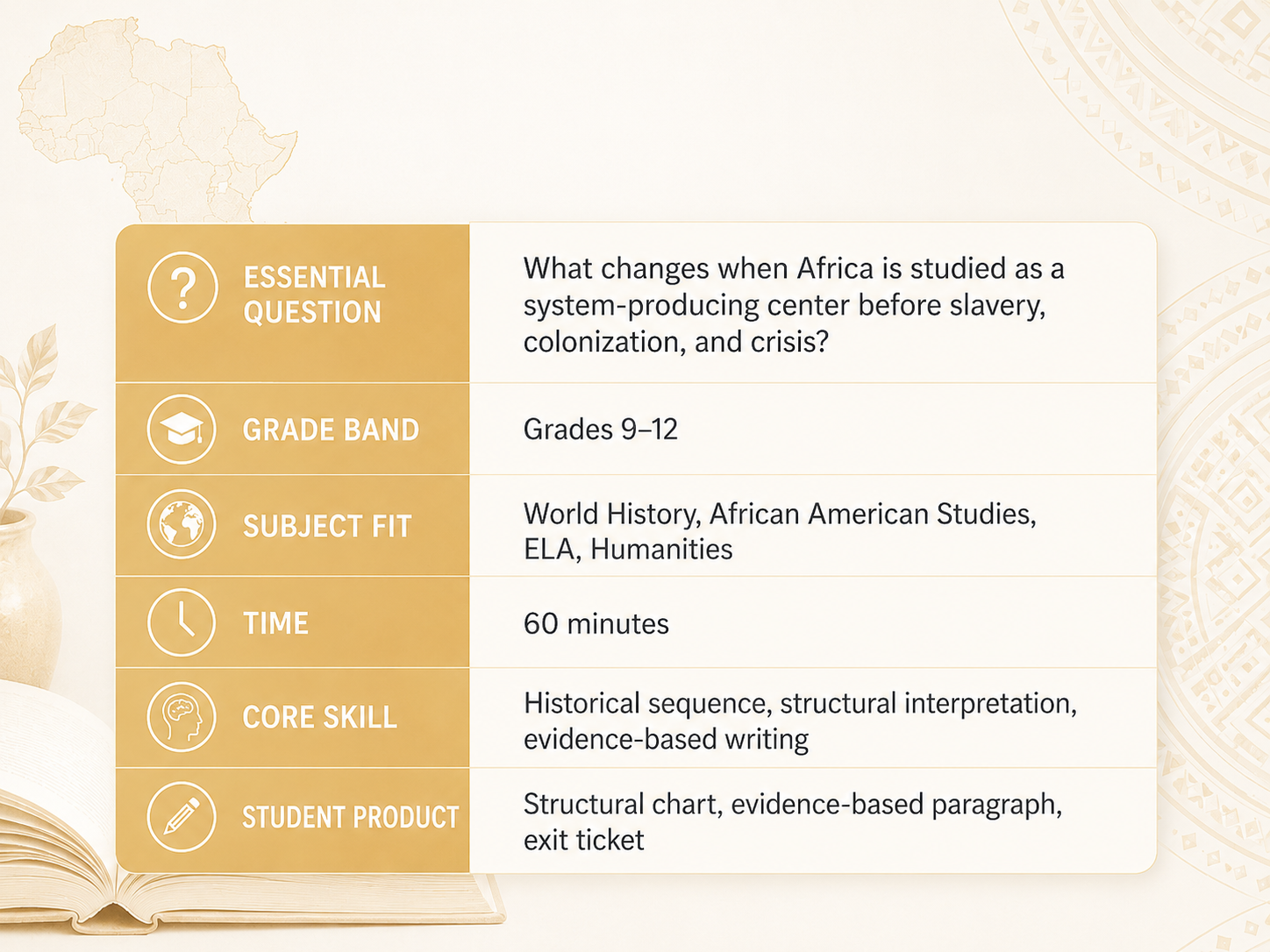
What becomes visible when Africa is studied as a system-producing center before slavery, colonization, and crisis?
Lesson Snapshot
Your Lesson at a glance

Teacher Purpose
This lesson helps students understand Africa before disruption. Students examine Africa as a system-producing center with governance structures, trade networks, knowledge transmission, energy bases, and systems of adaptation. The lesson challenges the common sequencing problem in which Africa enters instruction only through slavery, colonization, poverty, or crisis.
Students are asked to read structure, not just remember facts.
This connects to your broader Africana framework, which requires African civilizations to be analyzed through energy base, governance structure, trade network, knowledge transmission, and stress/adaptation factors.

Standards Alignment
-
Students cite evidence, determine central ideas, write explanatory responses, and participate in structured academic discussion.
-
Students cite evidence, determine central ideas, write explanatory responses, and participate in structured academic discussion.
-
Students cite evidence, determine central ideas, write explanatory responses, and participate in structured academic discussion.
-
Students cite evidence, determine central ideas, write explanatory responses, and participate in structured academic discussion.
-
Students cite evidence, determine central ideas, write explanatory responses, and participate in structured academic discussion.
-
Students cite evidence, determine central ideas, write explanatory responses, and participate in structured academic discussion.
-
Students cite evidence, determine central ideas, write explanatory responses, and participate in structured academic discussion.
-
Students cite evidence, determine central ideas, write explanatory responses, and participate in structured academic discussion.
Learning Objectives

Students will be able to:
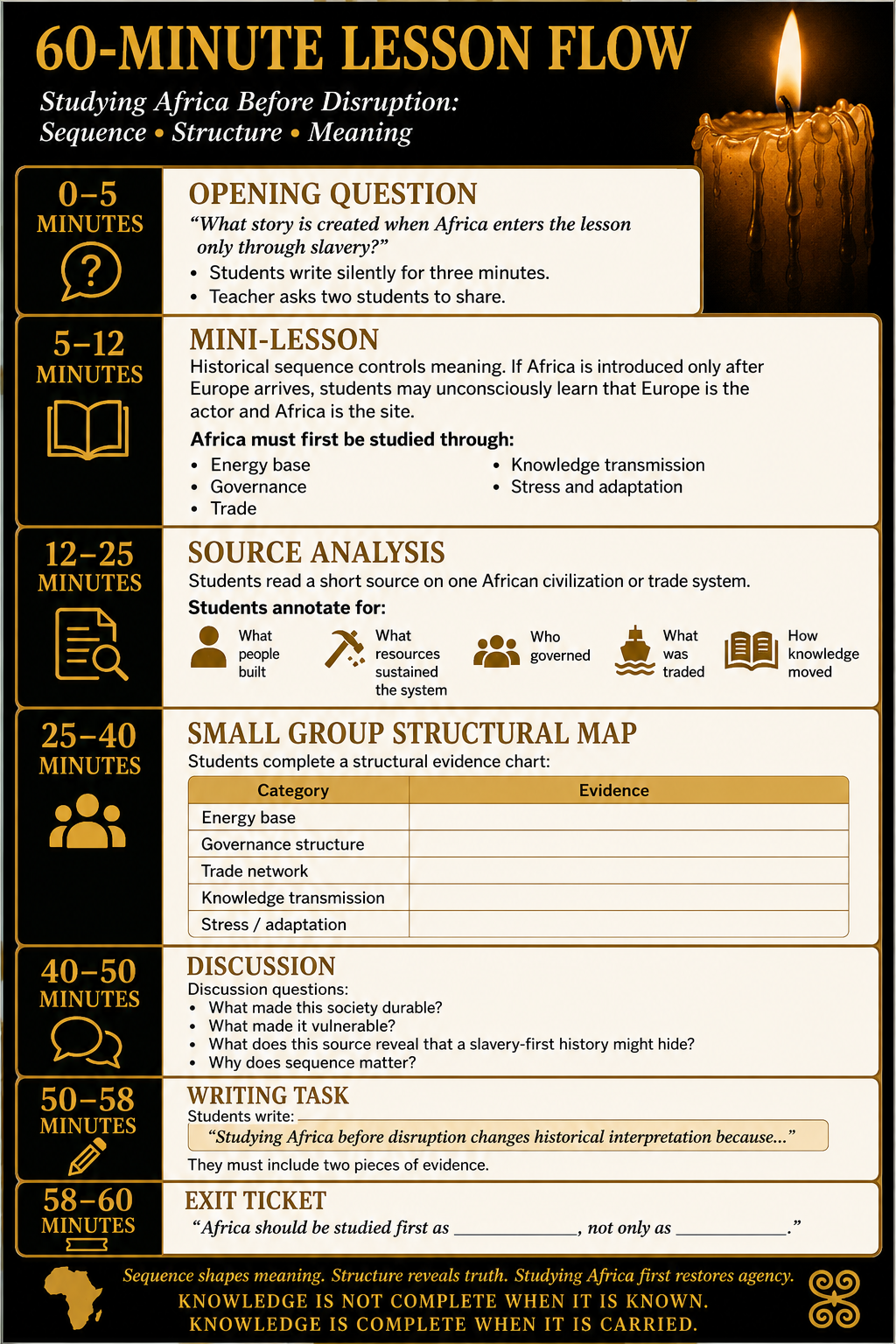
Explain why sequence matters in historical interpretation.
Identify African systems before European disruption.
Analyze Africa through governance, trade, knowledge transmission, and adaptation.
Write a short explanatory paragraph using textual evidence.

Key Vocabulary
Civilization
Governance
Trade network
Knowledge transmission
Sequence
Structural interpretation
Historical framing

Materials
Teachers May Use:
Short explainer on Mali, Ghana, Songhai, Kongo, Axum, Nubia, Great Zimbabwe, or Swahili city-states
Map of African trade routes
Short primary or secondary source excerpt
Student note catcher





If Needed